Tanzania, officially the United Republic of Tanzania, is a place where nature is at its wildest. It is surrounded by three great lakes of Africa – Lake Victoria, Lake Tanganyika and Lake Malawi.
Kilimanjaro , a dormant volcano, is snowcapped even though it is near the Equator.
Tanzania, the largest country in East Africa, includes the Spice Island of Zanzibar , Pemba , and Mafia and contains Africa’s highest point—Kilimanjaro , at 5,895 meters (19,340 feet).
The African population consists of more than 120 ethnic groups.
The flag of Tanzania consists of a black and yellow band, diagonally cutting out two triangles. The upper portion is green in color while the lower is blue.
The flag carries in it the 4 elements of Tanzania’s daily life. The green represents nature’s beauty, the yellow represents the mineral deposits of the country, the black represents the people, while the blue represents the great lakes.
Tanzania is just a little bit more than twice the size of California.
The shortest war in history was fought in 1896 in Tanzania between the United Kingdom and Zanzibar . It lasted only 45 minutes.
Over 120 languages are spoken in Tanzania. Most of these are Bantu languages, a category of over 535 languages and dialects that are spoken throughout Africa.
Mpingo trees (a.k.a. Africa blackwood trees, commonly seen in Tanzania) are the most expensive hardwood tree in the world.
The world’s earliest human skull was found in the Olduvai Gorge in Tanzania.
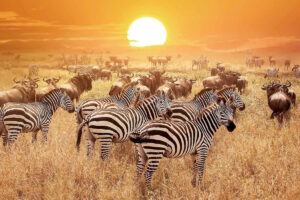
Tanzania has the largest concentration of wildlife animals per square kilometer, with more than 4 million wild animals and representatives of 430 species and subspecies.
Once upon a time, the ancestors of the wild elephants that live in Tanzania today didn’t roam on the land, they swam in the water! Dugongs were sea cows that lived in Tanzania in sheltered waters 55 million years ago. They grew about 3.5 meters in length and lived to be about 70 years old.
Mount Kilimanjaro is located in Tanzania. At 19,341 feet above sea level, it is the largest mountain in Africa.
Tanzania shares it national anthem with South Africa and Zimbabwe. It’s titled “Mungu Ibariki Afrika” (God Bless Africa) and was composed by Enock Sontonga.
Tanzania is divided into 26 regions (mikoa), 21 on the mainland, 3 on Zanzibar Island and 2 on Pemba Island. These are further divided into 99 districts (wilaya)! That’s a lot of parts and pieces to divide a socialist country into. The stacks of paper must be huge.
Tanzania is the home of the coconut crab. This crab, the largest crab in the world (and reportedly one of the most delicious), can be found on Chumbe Island of Zanzibar
Tanzania has the most expensive hardwood tree in the world; the Mpingo trees, also known as the African Blackwood trees.
Tanzania is made up of at least 120 tribes,each significant in their own way. Each of them is culturally distinguished by their unique masks, hand-woven baskets, batiks, poetry, items carved out of ebony or rosewood, etc.
The most famous national park of Tanzania is the Serengeti National Park (hyperlink to Serengeti description page) when a million wildebeests cross over to the Masai Mara National Park in Kenya. This migration is so epic, that it is named as one of the seven natural wonders of the world.
The earliest human skull in the world was discovered in Olduvai Gorge in Tanzania
With more than 4 million wild animals in its periphery, Tanzania has the largest concentration of animals per square kilometer, in the world.
And talking about wild, 30% of country’s area is occupied with National Parks, with 12 parks, 13 nature reserves, and 38 protected areas.
The highest freestanding mountain in the world, Kilimanjaro, is located in Tanzania. It is also the highest mountain in Africa.
Almost every type of ecological system can be found on Mount Kilimanjaro. This includes cultivated land, rain forest, heath, moorland, alpine desert, and an arctic summit.
Countries share food, flora and fauna, and several other things. But have you heard of any country that shares its national anthem? Tanzania does. With South Africa and Zimbabwe.
In the Zanzibar archipelago of Tanzania, one can find the largest crab in the world; the coconut crab. Said to be the most delicious as well. Attention all sea food fanatic!
Zanzibar,a port city of Tanzania, is a cosmopolitan hotspot which dominates East African culture. Its long history with Arab rulers, Indian workers, Portuguese traders and European colonizers have created a unique blend of traditions, cuisine, music, dance forms, and arts.
In Tanzania, even the lakes are sculptors. Lake Natron, a highly alkaline water body, is known to turn birds and other animals into ghastly stone statues.
The most famous national park of Tanzania is the Serengeti National Park when a million wildebeests cross over to the Masai Mara National Park in Kenya. This migration is so epic, that it is named as one of the seven natural wonders of the world.
The Serengetiis home to the the Ol Doinyo Lengai; the only volcano on the planet that is currently erupting carbonatite lava. This mineral rich carbonate lava is washed down to the plains where it fertilizes the land.
The Ruaha National Park is the home to largest population of wild elephants in all of Eastern Africa.
Tanzania also houses the world’s largest volcanic crater, Ngorongoro , with a diameter of 19kms and is 600m deep.
Remember Freddie Mercury? Who doesn’t?! The lead vocalist of the English band ‘Queen’ is a Tanzanian by birth and was born in the archipelago of Zanzibar , in Stone Town. And, by the way, his real name is Farrokh Bulsara! That’s something you probably must have known.
Tanzania has two capital cities. Dar es Salaam (the administrative capital) and Dodoma city (the legislative capital) where its parliament sits.
Have you ever seen a lion climbing trees? May be on television. Well, what you saw was a shot from the Lake Manyara National Park ; the home to world’s only tree climbing lions.
Tanganyika, a British-controlled UN trust territory, gained independence in 1961; and Zanzibar, a British protectorate with an Arab population, became independent in 1963. Tanganyika and Zanzibar united to form Tanzania in 1964. Until resigning as president in 1985, independence leader Julius K. Nyerere guided two decades of socialism—adapted to the ujamaa policy of village farming. A multiparty system was established in 1992 after a constitutional amendment.
Some 80 percent of Tanzanians farm or fish at subsistence levels; in many areas tse-tse fly infestation hampers successful animal husbandry.
Tanzania is one of the last remaining places when the possibility of discovering a new species still exists. In 2003, a new monkey, the kipunji, was discovered and is extremely rare with a population of only about one thousand animals.
Dar es Salaam is the administrative capital, but Dodoma is the designated future capital and current home to Tanzania’s legislature.
The de-facto national dish of Tanzania is the humble Ugali. It’s a simple porridge made with millet or sorghum flour.
Mpingo tree, found in Tanzania produces the costliest timber in the world.It has exceptional mechanical properties that make it perfect for carving and it has a beautiful finish.
Climate: varies from Tropical along coast to temperate in highlands.
Tanzanianslove hip hop music and has created Bongo Flava, which is an amalgamation of international styles like reggae, afrobeat, blues, rasta and dancehall with local musical traditions like taarab and dansi.
Population: 36,481,000
Capital: Dar es Salaam (administrative); 2,683,000—Dodoma (legislative); 155,000